The poster gallery is one event in the MFI Making Connection program, running from September 2023 to February 2024. The posters are permanently archived as a record of the ideas around lives, conditions, and futures explored during the festival.
The posters feature the work of the Mapping Future Imaginaries network members. The posters showcase projects, speculations, experiments, and practices into the themes of the program – to explore the significance of the creative encounter for social connection.
Click on the posters to explore them in more detail, and we invite you to contact each creator for more information.
Kiera O’Toole
Visual Artist, Doctoral Researcher, Loughborough University, UK, Assistant Lecturer for the MA for Creative Practice, Atlantic Technological University, Ireland.
Contact me: kieraotooleartist@gmail.com http://www.kieraotooleartist.com
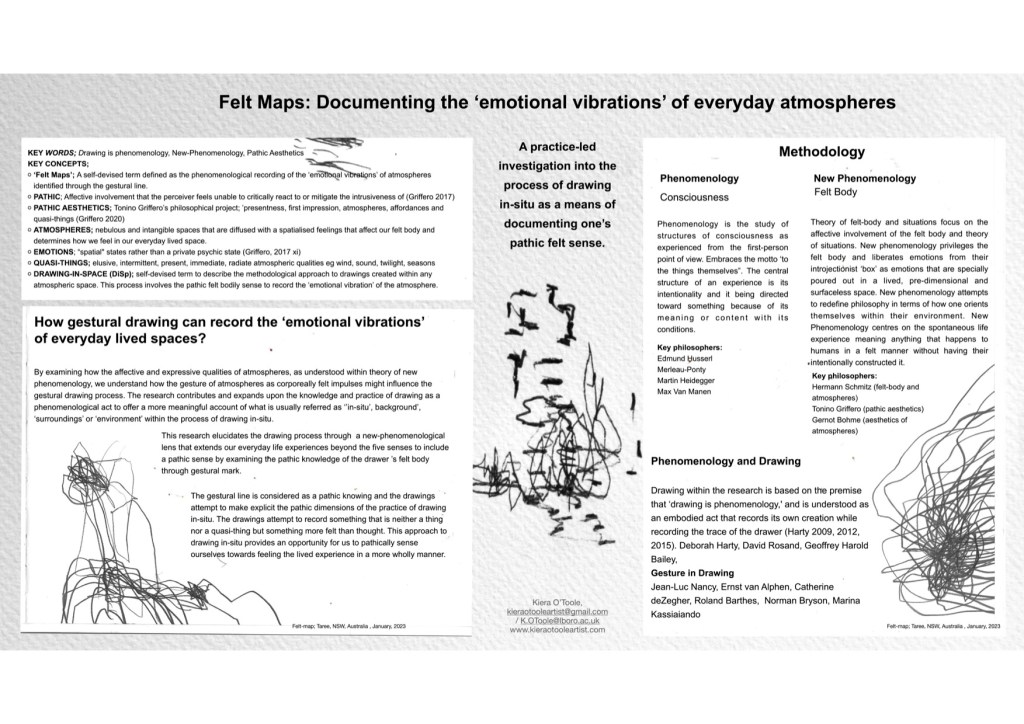
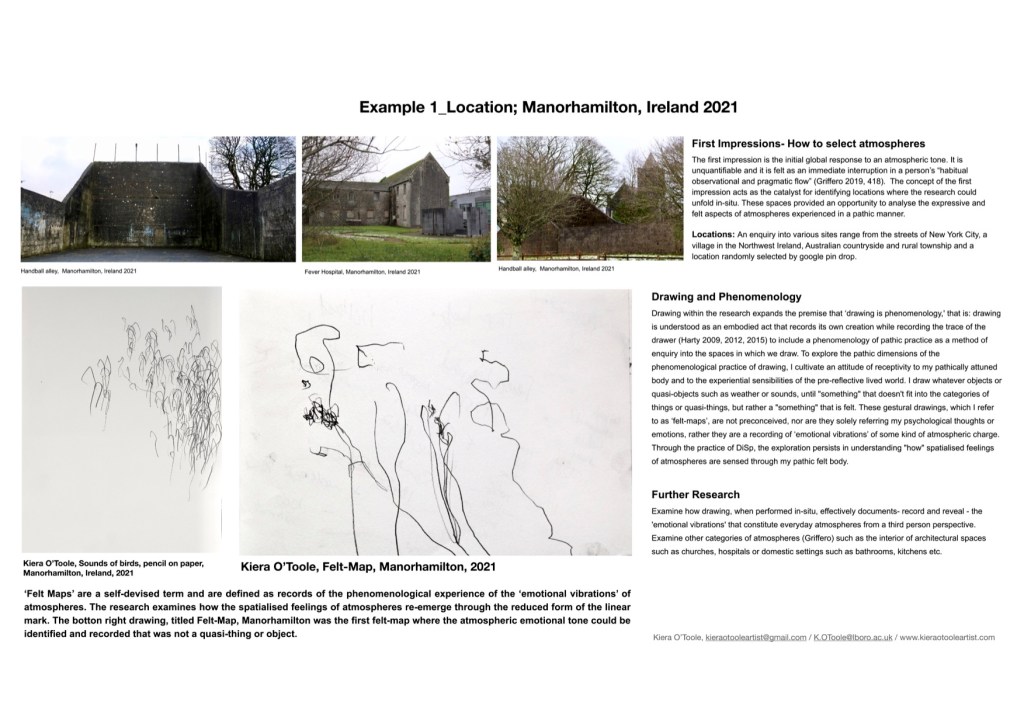
Felt Maps: Documenting the ’emotional vibrations’ of everyday atmospheres
This practice-led research examines the process of drawing in-situ as a means to document one’s pathic felt-bodily sense. By examining how the affective and expressive qualities of atmospheres, as understood within the theory of new phenomenology, we understand how the gesture of atmospheres as corporeally felt impulses might influence the gestural drawing process. By examining the pathic knowledge of the drawer’s felt body, the research examines how the spatialised feelings of atmospheres can re-emerge through the reduced form of the linear mark.The research elucidates this drawing process through a new-phenomenological lens that extends our everyday life experiences beyond the five senses to include a pathic sense.
Drawing within the research expands the premise that ‘drawing is phenomenology,’ that is: drawing is understood as an embodied act that records its own creation while recording the trace of the drawer (Harty 2009, 2012, 2015) to include a phenomenology of pathic practice as a method of enquiry into the spaces in which we draw. The drawings are referred to as ‘Felt Maps’ which is a self-devised term and are defined as records of the phenomenological experience of the ‘emotional vibrations’ of atmospheres. This research contributes and expands upon the knowledge and practice of drawing as a phenomenological act to offer a more meaningful account of what is usually referred as ‘’in-situ’, background’, ‘surroundings’ or ‘environment’ within the process of drawing in-situ process.
Andreia Peñaloza Caicedo
Architect and educator
Contact me: casiopea.architecturando@gmail.com

Architecturing-with All Creatures
A pedagogical tool that invites children and other creatures to dream and make spaces-architectures that seem impossible in the present, for building a creaturely-centric future that acknowledges the capacities, possibilities and mutual relations between human and other-than-human creatures.
Benjamin Sheppard
Artist and Academic at RMIT in the School of Art, Melbourne, Australia
Contact me: ben@benjaminsheppard.com @benjaminscottsheppard http://www.benjaminsheppard.com.au
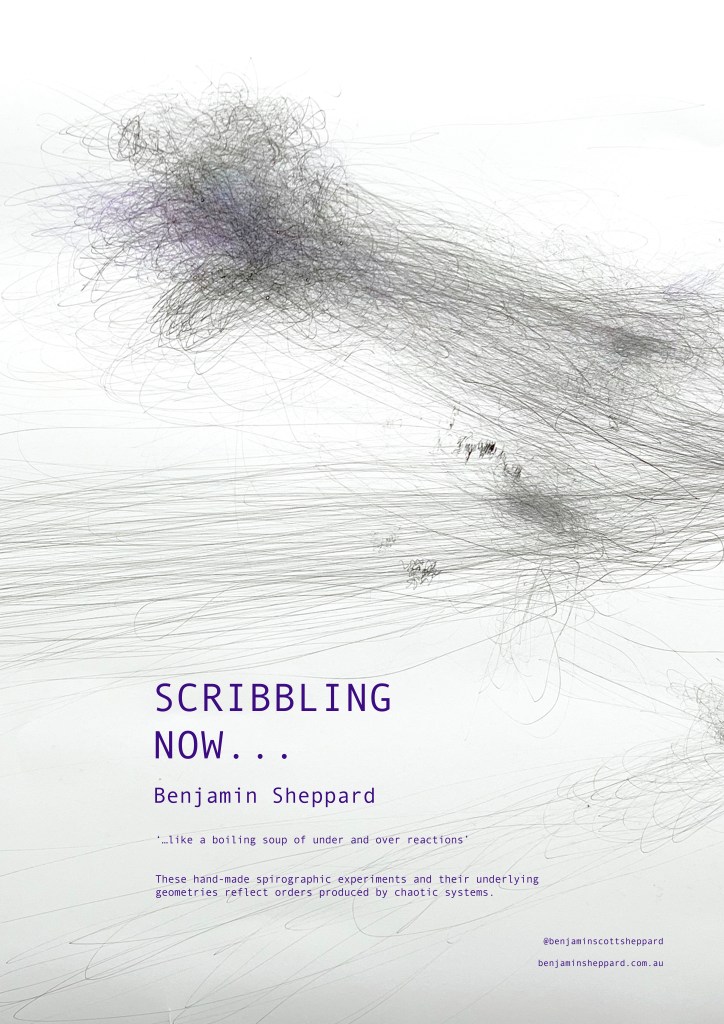

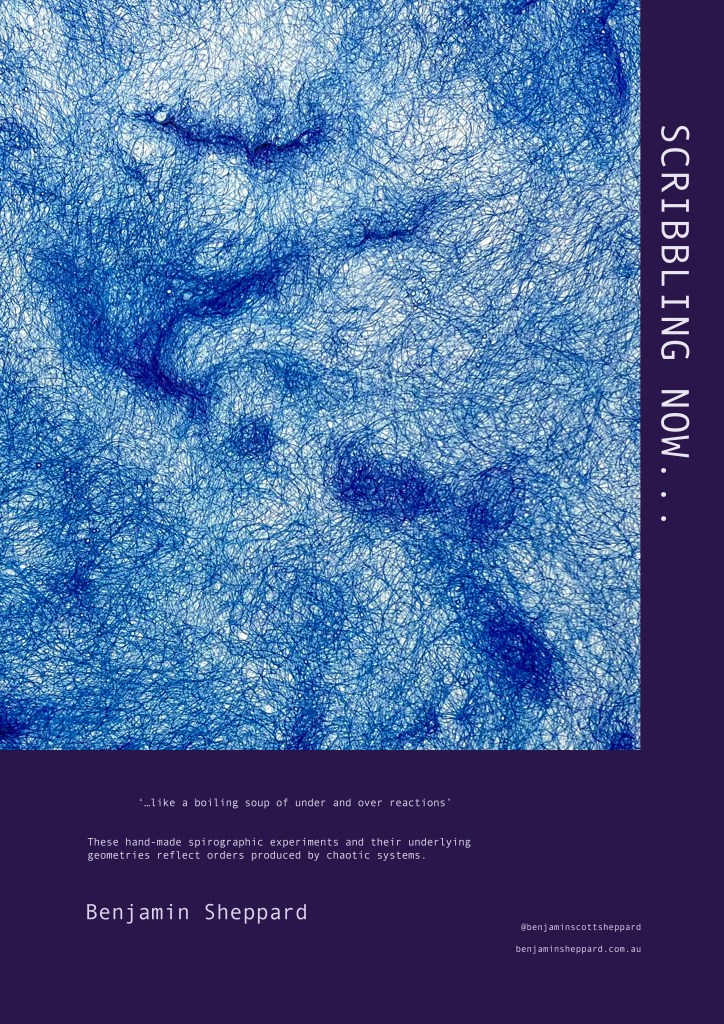
Scribbling Now…
‘…like a boiling soup of under and over reactions’ PD August 2023
These hand-made spirographic experiments and their underlying geometries explore and reflect on the order produced by chaotic systems. Born from the four-part rotary pivots of shoulder, elbow, wrist, with the ultimate release from the finger-thumb pince, these seemingly chaotic scribbles often coalesce to reveal tiny circular absences amongst curious accumulations of line.
Constellations of absence and form evoke the cosmic while alluding to the self-similar relationships of other systems—be they of nature or culture.
Leah Sandler
Artist, and Adjunct Professor, University of Cenrtral Florida / Valencia College, Florida
Contact me: msandler@uarts.edu https://leahsandler.art/

The Center For Post-Capitalist History: The Human Scale of Time Exists Within
the Geological Scale of Time
The Center For Post-Capitalist History, a fictitious museum existing through para-fictional intervention, proposes the creation of new methods of understanding history after the decline of Capitalism due to climate catastrophe and economic inequality. In the institution’s vision, the body should be understood as a valuable archive of information that can reorient our understanding of knowledge production and the writing of history, and allow us to prioritize care and mutual aid in a proposed future after the Capitalocene.
This poster, in a gesture of detournement of slick, corporate design, imagines how the
para-fictional institution might implement a brand strategy for a campaign to increase awareness of human-ecological entanglements.
Kimbal Bumstead
Artist.
Contact me: hello@kimbalbumstead.com @kimbalbumstead http://www.kimbalbumstead.com
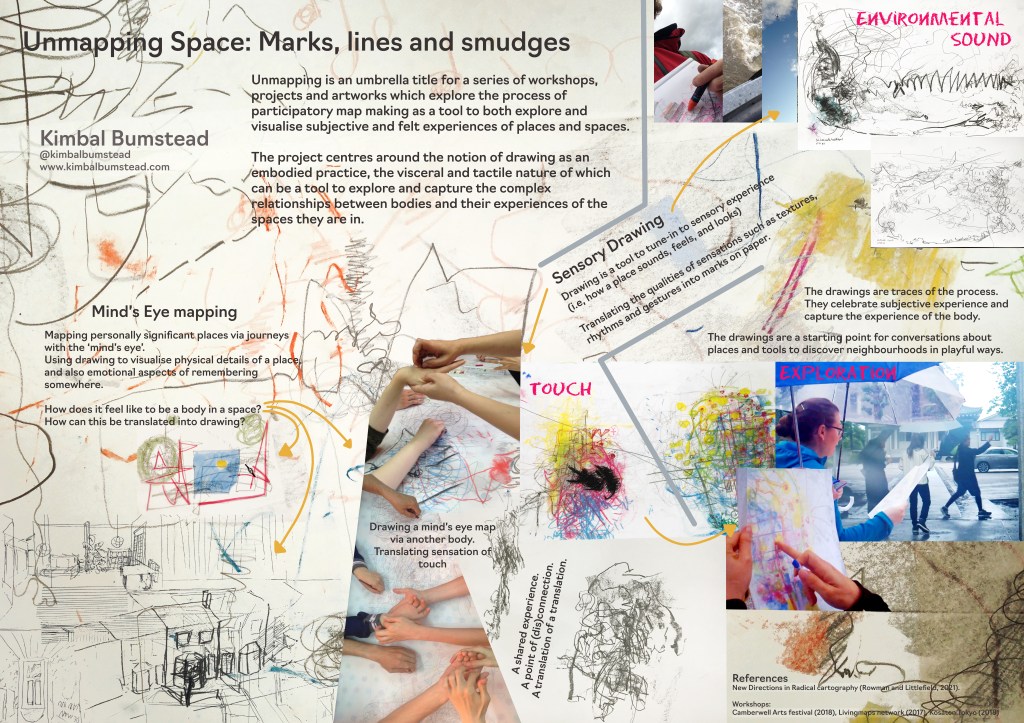
Unmapping Space: Marks, Lines and Smudges
Unmapping is an umbrella title for a series of workshops, projects and artworks which
explore the process of participatory map making as a tool to both explore and visualise subjective and felt experiences of places and spaces. The project centres around the notion of drawing as an embodied prac:ce, the visceral and tactile nature of which can be a tool to explore and capture the complex rela:onships between bodies and their experiences of the spaces they are in.
The key premise behind these projects is that the physical act of making marks on paper is considered a tool to ‘tune-in’, not only to physical or sensory experiences in the present moment (i.e., the sensation of touch and hearing environmental sound) but also to emotional aspects of how places exist in our memories and imaginations.
Yanina Carrizo
Early childhood teacher, PhD student, RMIT School of Education
Contact me: yaninacarrizo25@hotmail.com
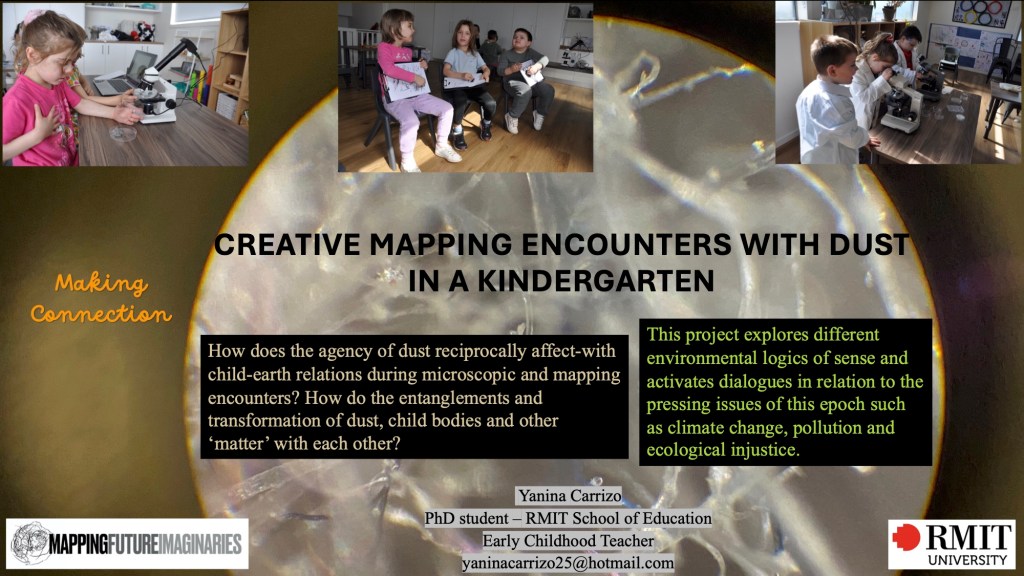
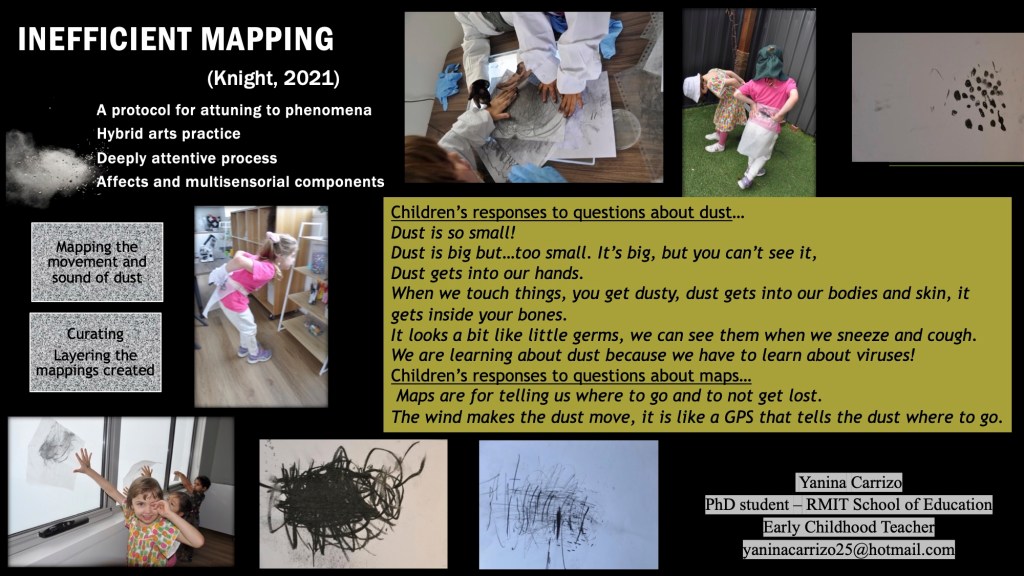
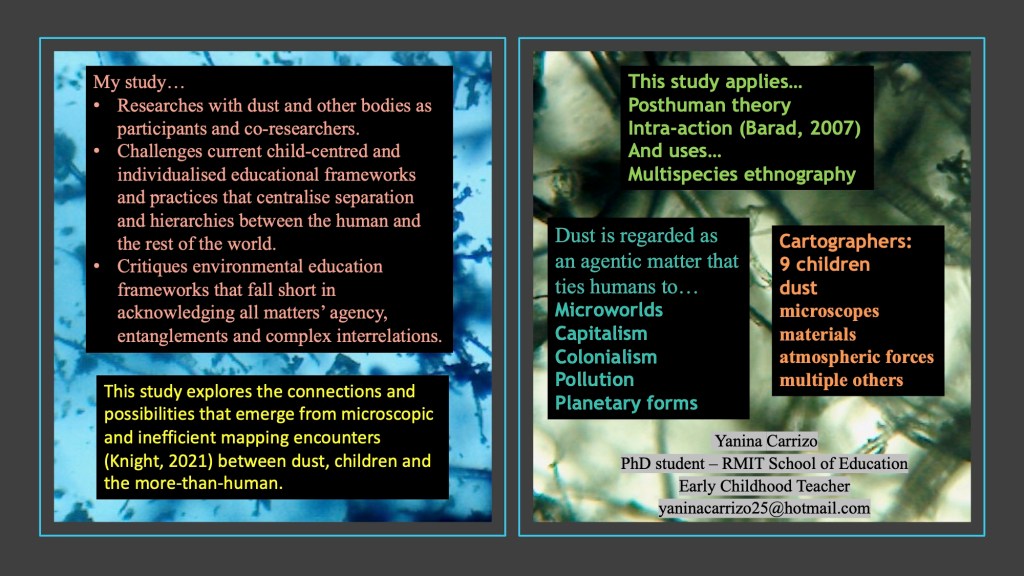
Creative Mapping Encounters with Dust in a Kindergarten
This project explores different environmental logics of sense and activates dialogues in relation to the pressing issues of this epoch such as climate change, pollution and ecological injustice. It asks: How does the agency of dust reciprocally affect-with child-earth relations during microscopic and mapping encounters? How do the entanglements and transformation of dust, child bodies and other ‘matter’ with each other?
Dani Andrée
Technical Officer (Textiles Print and Construction), Masters student, RMIT University, Australia
Contact me: danielle.andree@rmit.edu.au

Perennial Series’ Nourishment Ritual as Studio Methodology
Meditative-contemplative thinking is cultivated in Perennial series’ nourishment ritual through the binding together of the artist and a Tagetes lucida plant within the artist’s garden. This studio methodology is recorded through time-lapse photography and stream-of-consciousness notes, guiding artworks that can counter instrumental interpellations of plant-life.
Megan McPherson
Faculty of Fine Arts and Music, University of Melbourne, Australia
Contact me: http://www.meganmcpherson.com.au
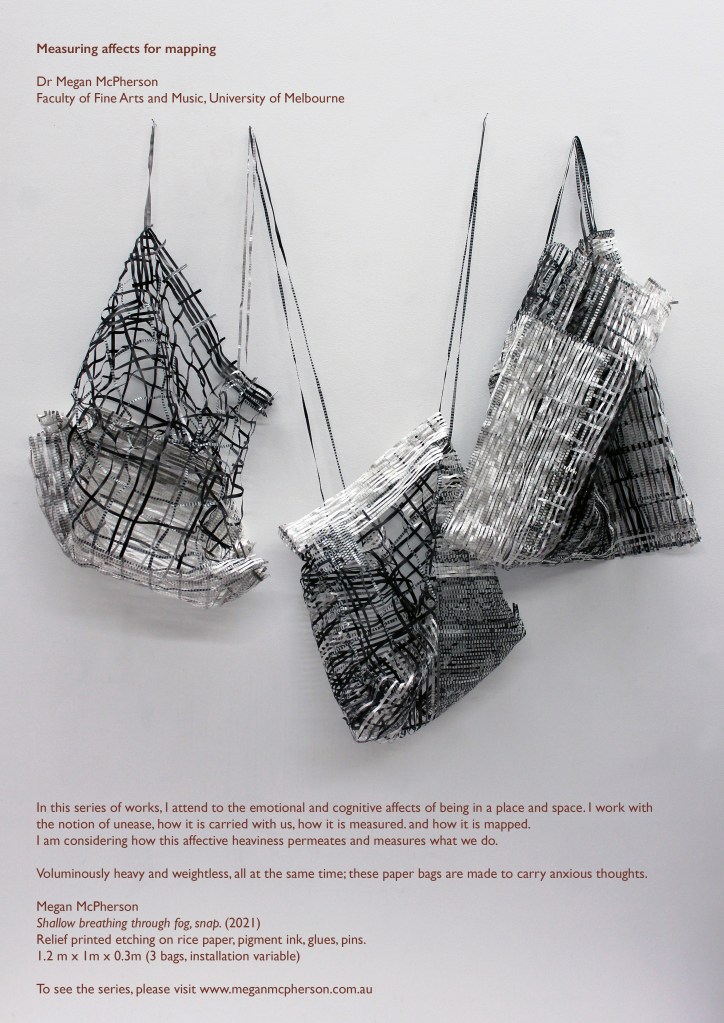
Measuring affects for mapping
In this series of works, Measuring affects for mapping I attend to the emotional and cognitive affects of being in a place and space. I work with the notion of unease; how it is carried with us, how it is measured and how it is mapped. In the chapter, The feeling of doingthinking and thinkingdoing of making processes (McPherson, 2022), I describe and theorise through the processes of making. I gather together the embodied, matter, material, affective experiences and measure sometimes unperceivable transformative changes. Those changes that are emergent niggle at the edges, show the ways of unknowing, unfinished, and unforeclosed, and the otherwise. I consider recent theoretical approaches on making from human geography, creative practice methodologies, and art practice research to consider how agency, care, and the agentic actions of making address the academy. I document my experiences of establishing a new research project alongside my research-creation practices and consider the actions of doingthinking and thinkingdoing. Activating such knowledges in the academy, which considers these knowledges as otherwise, is approached in this chapter as actions of care, care-ful practices, and self-care.
By mapping through making, I am considering how this affective heaviness permeates and measures what we do. I attend to the contextualising work that mapping does, giving points of reference, and overlaying knowledge of what has gone before the creation of the map. Voluminously heavy and weightless, all at the same time; these paper bags are made to carry anxious thoughts.
Clare McCracken & Nicole Bilson
Clare is an artist and early career academic, School of Art, RMIT University, Australia
Contact me: clare.mccracken@rmit.edu.au
Nicole is a freelance writer and Wine and Spirits Education Trust educator, Melbourne, Australia
Contact me: nicolebilson@hotmail.com
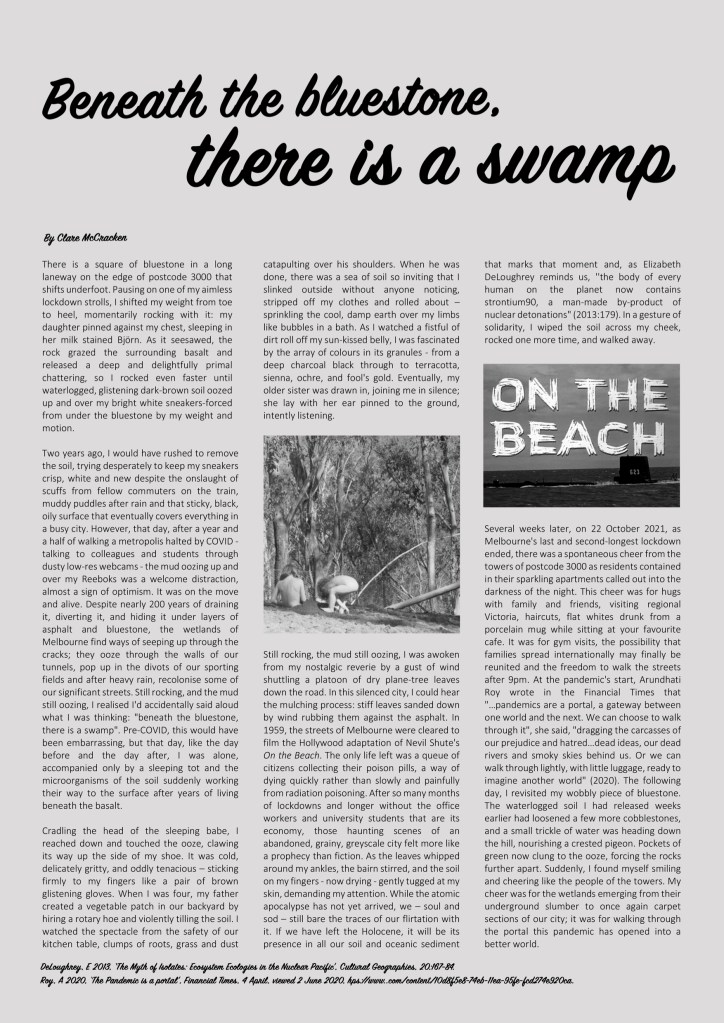
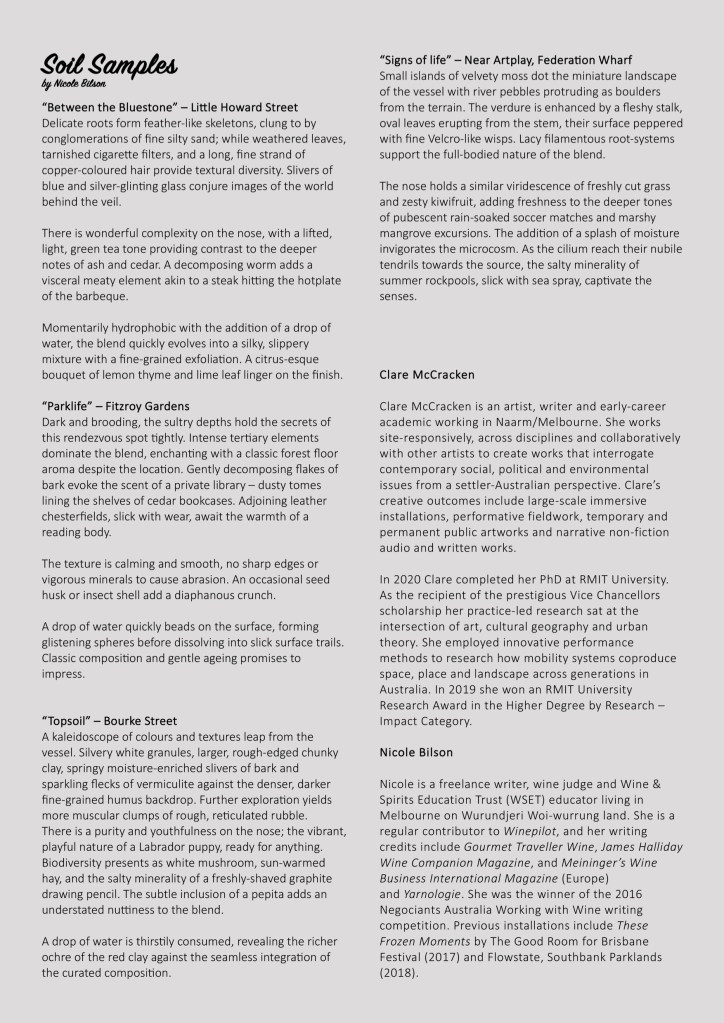
Beneath the bluestone, there is a swamp…
Almost all terrestrial life on Earth depends on soil – from microorganism through to plants and animals – yet, as Tim Ingold has noted, modern cities insulate us from sensing soil (2004). This project used creative practice to render soil’s aliveness tangible: to ask how can creative practitioners render urban soil visible? Creative writing and the highly trained olfactory of a sommelier collaborated to demonstrate how soil can be smelt, felt, and seen.
 Mapping Future Imaginaries